
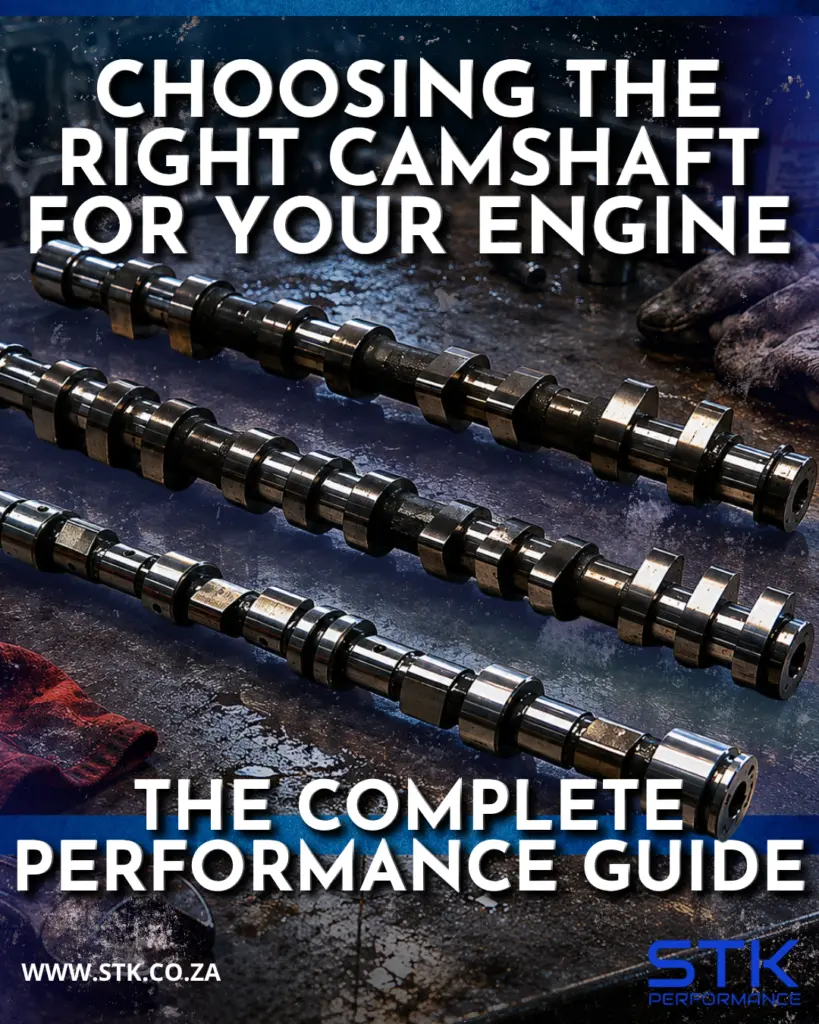
When building a performance engine, the camshaft is one of the most important components in the entire setup. It determines how your engine breathes, where it makes power, how aggressive it sounds, and whether the car feels enjoyable on the street or only comes alive at high RPM.
At STK Performance, the camshaft range is specifically designed around real-world performance applications for VW 8V, Opel 8V, Audi 1.8T 20V, and naturally aspirated 20V engines — from reliable daily drivers to full race builds.
What Does a Camshaft Actually Do?
The camshaft controls:
- Valve opening timing
- Valve closing timing
- Valve lift
- Valve overlap
These factors directly affect:
- Torque
- Horsepower
- Turbo spool
- Idle quality
- Fuel consumption
- RPM range
- Throttle response
A small camshaft usually improves drivability and low-end torque, while a larger camshaft shifts power higher into the rev range for more top-end performance.
Understanding Camshaft Duration
Camshafts are commonly identified by their duration numbers:
- 268H
- 272H
- 276H
- 288H
- 298H
- 304S
- 320S
The higher the number, the longer the valves stay open.
Smaller Camshafts (268H – 272H)
Smaller duration cams are ideal for:
- Daily driving
- Mild street builds
- Turbo street cars
- Reliable weekend cars
Benefits include:
- Smooth idle
- Strong low-end torque
- Faster turbo spool
- Better drivability
- Lower maintenance
The STK VW 8V 272H Camshaft is designed specifically for responsive street performance while maintaining excellent drivability.
For naturally aspirated 1400cc and 1600cc applications, the 272H profile works exceptionally well for everyday performance without sacrificing reliability or low-end response.
Mid-Range Performance Camshafts (276H – 288H)
These are some of the most popular street-performance camshafts because they offer an excellent balance between:
- Street drivability
- Aggressive sound
- Midrange power
- Top-end performance
Perfect for:
- Fast road cars
- Weekend toys
- Street/strip builds
- Modified naturally aspirated engines
The STK Camshaft Kit 276H VW 8V is aimed at performance street applications with improved airflow and a broader powerband.
The STK Camshaft Kit 288H VW 8V is one of the best all-round fast-road setups available for VW 8V engines. It offers:
- Strong midrange
- Excellent top-end pull
- Hydraulic lifter reliability
- Broad torque curve
- Quiet operation
STK specifically describes the 288H kit as ideal for “street and fast-road applications with quiet operation, low maintenance, and broad torque curve.”
For 1800cc and 2.0L street builds, a 276H or 288H setup is often the sweet spot.
Aggressive Track and Race Camshafts (298H – 320S)
Larger camshafts are designed for engines operating at high RPM.
These cams are best suited for:
- Track cars
- Drag racing
- Rally builds
- Circuit racing
- High-compression naturally aspirated engines
The trade-off:
- Rough idle
- Reduced low-end torque
- Less street comfort
- Higher maintenance
The STK 304S VW 8V Camshaft Kit is built specifically for:
- High-RPM performance
- Track applications
- Rally use
- Drag racing
According to STK, the 304S kit delivers:
- “Razor-sharp throttle response”
- “Exceptional top-end power”
- Stable valve control at elevated RPM
These aggressive solid-lifter profiles are designed for serious motorsport applications rather than daily driving.
Hydraulic vs Solid Lifter Camshafts
One of the most important choices when selecting a camshaft is deciding between hydraulic and solid lifters.
Hydraulic Camshafts
Hydraulic setups are found in most street performance engines.
Advantages:
- Quiet operation
- Minimal maintenance
- Better street manners
- Easier installation
- Excellent reliability
STK hydraulic kits include precision hydraulic followers and matched valve train components for reliable street performance.
Best hydraulic profiles:
- 268H
- 272H
- 276H
- 288H
These are ideal for:
- Daily drivers
- Fast road builds
- Mild turbo applications
Solid Lifter Camshafts
Solid lifter setups are designed for extreme RPM stability and aggressive cam profiles.
Advantages:
- Better valve control
- Higher RPM capability
- More aggressive ramp rates
- Superior race performance
Disadvantages:
- Requires lash adjustment
- More maintenance
- Rougher idle
- Less street-friendly
STK’s solid-lifter 299S, 300S, 304S, and 320S kits are purpose-built for high-performance motorsport applications.
Choosing the Right Camshaft for Your Engine
VW 8V Engines
VW 8V engines respond exceptionally well to camshaft upgrades.
Recommended STK Profiles
| Engine Setup | Recommended Camshaft |
|---|---|
| 1400 / 1600 Daily Driver | 272H |
| 1800 Street Car | 276H |
| 2.0L Fast Road | 288H |
| Turbo Street Build | 268/276H Turbo |
| Aggressive NA Build | 298H |
| Full Race Build | 304S / 320S |
STK offers complete matched camshaft kits for all of these applications, including:
- Dual valve springs
- Forged valves
- Retainers
- Lifters or cam buckets
- Matched valve train components
Turbo Camshafts vs Naturally Aspirated Camshafts
Turbo engines and naturally aspirated engines require very different camshaft designs.
Turbo Camshafts
Turbo engines generally prefer:
- Lower overlap
- Faster spool
- Better boost retention
- Strong midrange torque
The STK 268/276H Turbo VW 8V Kit is designed specifically for turbo street applications with:
- Broad torque curve
- Improved throttle response
- Strong drivability
- Hydraulic reliability
For turbo street builds, oversized camshafts often reduce responsiveness and hurt spool characteristics.
Naturally Aspirated Camshafts
Naturally aspirated engines depend heavily on airflow efficiency.
Larger NA cams typically provide:
- Better top-end power
- Higher RPM capability
- Increased airflow
- More aggressive powerbands
The Audi 1.8 NA 20V Camshaft Kit 288H is designed for naturally aspirated 20V applications where high-RPM airflow is critical.
Audi 1.8T 20V Camshaft Selection
Turbocharged Audi 1.8T engines need a different approach compared to naturally aspirated builds.
The Audi 1.8T 20V Camshaft Set 252/262HT is designed specifically for turbocharged applications and focuses on:
- Turbo spool
- Midrange torque
- Improved airflow under boost
- Street reliability
For most street-driven 1.8T setups, moderate turbo-specific profiles outperform overly aggressive race cams.
Supporting Mods Matter
A camshaft should never be selected in isolation.
Proper supporting modifications include:
- Valve springs
- ECU tuning
- Exhaust upgrades
- Compression ratio matching
- Intake flow improvements
STK camshaft kits include matched valve train components specifically engineered to work together under increased RPM and valve lift.
Why Valve Springs Are Critical
One of the most overlooked upgrades is the valve spring setup.
Weak springs can cause:
- Valve float
- Power loss
- Misfires
- Engine damage
STK kits include dual valve springs manufactured from premium chrome silicon steel for improved high-RPM valve control.
Common Camshaft Mistakes
Choosing Too Big
The biggest mistake enthusiasts make is choosing an overly aggressive camshaft.
A huge cam:
- Can reduce usable power
- Makes the car unpleasant to drive
- Hurts low-end torque
- Requires extensive supporting mods
Bigger is not always faster.
Ignoring Engine Purpose
Always choose a camshaft based on:
- Vehicle weight
- Intended use
- RPM range
- Turbo setup
- Compression ratio
Skipping ECU Tuning
A performance camshaft without tuning leaves major performance gains unused.
Professional tuning is essential after installing:
- Larger cams
- Higher compression
- Turbo cam profiles
Final Thoughts
Choosing the correct camshaft is about balance.
The best setup is not always the biggest or most aggressive — it’s the one that matches:
- Your engine build
- Your RPM range
- Your turbo setup
- Your driving style
- Your intended use
For most street-driven vehicles, hydraulic 276H and 288H setups offer the best balance of:
- Power
- Reliability
- Drivability
- Maintenance
For serious competition engines, solid-lifter profiles like the 304S and 320S provide the high-RPM stability and aggressive power delivery needed for racing.