
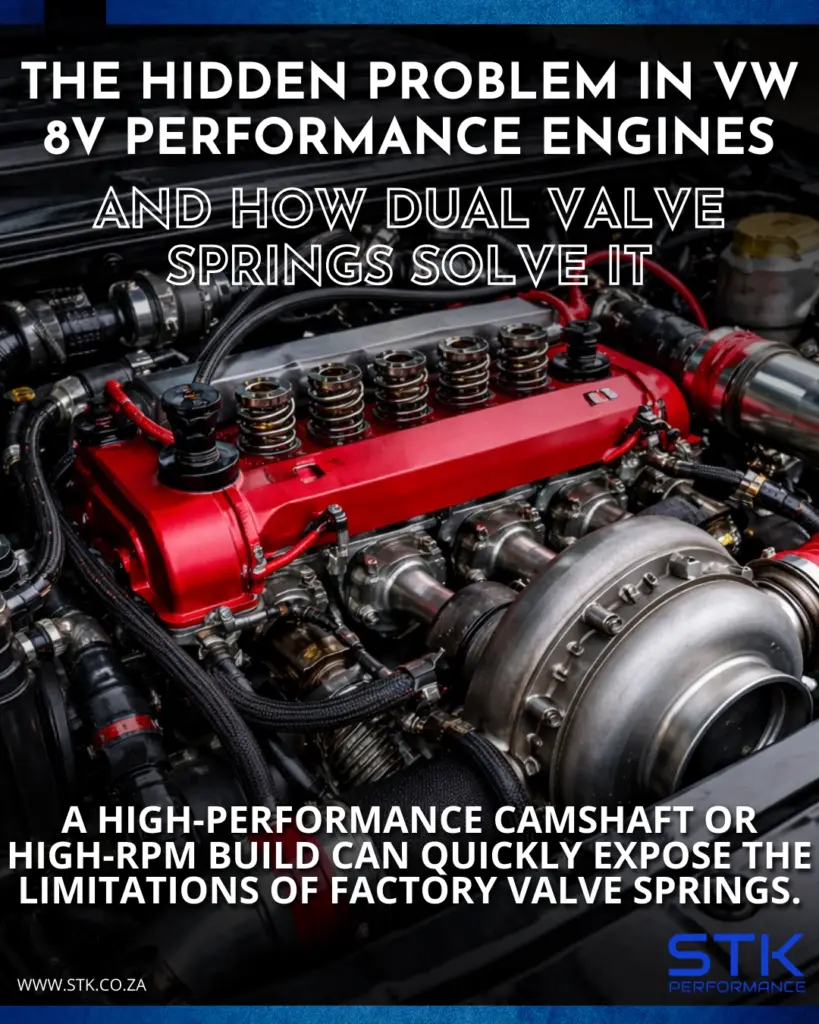
When building or upgrading a VW 8-valve engine, most people focus on the obvious performance upgrades: camshafts, ported cylinder heads, turbo systems, or ECU tuning. But there is a critical component in the valvetrain that is often overlooked — the valve springs.
A high-performance camshaft or high-RPM build can quickly expose the limitations of factory valve springs. This is where a dual valve spring kit, designed specifically for VW 8V engines, becomes essential.
This article explains the real problem these kits solve, why it matters for performance engines, and how upgrading to dual valve springs can prevent serious engine damage.
The Problem: Valve Float in High-Performance Engines
One of the biggest problems in modified engines is valve float.
Valve float happens when the valve spring cannot close the valve quickly enough as engine RPM increases. When this happens, the valve stops following the camshaft profile correctly.
Instead of opening and closing precisely, the valve may:
-
Stay open longer than intended
-
Bounce on the valve seat
-
Fail to close before the piston reaches top dead center
When this happens, several serious issues can occur:
-
Loss of engine power
-
Poor combustion efficiency
-
Valve overheating
-
Camshaft wear
-
In extreme cases, piston-to-valve contact that can destroy the engine
Valve float becomes especially common in engines that:
-
Rev beyond the factory redline
-
Use aggressive aftermarket camshafts
-
Run high boost
-
Are used in racing or drifting
Why Stock VW 8V Valve Springs Struggle
Factory valve springs in most VW 8V engines were designed for reliability and everyday driving, not extreme performance.
When performance modifications are added, the original springs may not have enough seat pressure and spring rate to control the valves properly.
Situations that increase stress on valve springs include:
High RPM
As engine speed increases, the valve train components move faster and experience greater inertia. If the spring cannot react quickly enough, the valve will float.
Many performance builds exceed 7,000 RPM, which pushes stock springs beyond their safe operating range.
Aggressive Camshafts
Performance camshafts increase:
-
Valve lift
-
Duration
-
Acceleration of valve movement
Stock springs often cannot control these aggressive profiles. Upgraded springs are required to maintain proper valve timing.
Turbo and High Cylinder Pressure
Turbocharged engines create higher cylinder pressure, which increases the load on the valvetrain.
Stronger springs are necessary to ensure the valves close properly under boost conditions.
The Solution: Dual Valve Spring Kits
A dual valve spring kit uses two springs — an inner and outer spring — working together to control valve motion.
Instead of relying on a single spring, the system uses two concentric springs to provide greater control and stability.
Typical kits for VW 8V engines include:
-
Inner and outer valve springs
-
High-strength retainers
-
Increased seat pressure and open pressure ratings
How Dual Valve Springs Solve the Problem
Prevent Valve Float
The additional spring force ensures the valve closes quickly and follows the camshaft precisely.
This prevents the valve from floating at high RPM and keeps engine timing accurate.
Improve Valve Train Stability
Dual springs also reduce harmonic resonance, which can cause valve bounce or instability.
The inner and outer springs operate at slightly different frequencies, helping absorb vibrations and maintain consistent valve control.
Enable Higher RPM
With stronger valve control, the engine can safely operate at higher RPM ranges.
This is critical for:
-
Racing builds
-
Drift cars
-
High-performance street builds
Stronger springs allow the valvetrain to remain stable even under aggressive driving conditions.
Protect the Engine from Catastrophic Failure
Without proper valve control, the worst-case scenario is piston-to-valve contact.
Dual valve springs reduce this risk by ensuring valves always close when they should.
This protects critical engine components such as:
-
Pistons
-
Valves
-
Camshafts
-
Lifters
-
Cylinder head components
When You Should Upgrade to Dual Valve Springs
A dual valve spring kit is strongly recommended if your VW 8V engine has:
-
A performance camshaft such as a 272H, 276H, or more aggressive profile
-
Increased RPM limits
-
Turbo or supercharger upgrades
-
Ported cylinder heads
-
Track, racing, or drift use
Even on performance street builds, upgrading the valve springs ensures the valvetrain remains stable and reliable.
Final Thoughts
In performance engine building, small components often make the biggest difference. Valve springs may not be the most visible upgrade, but they are one of the most important for protecting and unlocking the full potential of a VW 8-valve engine.
A dual valve spring kit provides the control, stability, and strength needed for high-performance builds. By preventing valve float and maintaining precise valve timing, these kits help ensure that your engine performs reliably under the demanding conditions of racing, drifting, or aggressive street driving.
For anyone pushing the limits of a VW 8V engine, upgrading to dual valve springs is not just a performance improvement — it is essential insurance for the entire valvetrain.